Towards Finding Invisible Whiskers in Fossil Crocs

Our paper on Alligator Trigeminal Nerve Scaling and Significance is out in Anatomical Record:

http://onlinelibrary.wiley.com/doi/10.1002/ar.22666/pdf

You can catch University of Missouri’s press release here:

https://nbsubscribe.missouri.edu/news-releases/2013/0404-new-measurement-of-crocodilian-nerves-could-lead-to-better-understanding-of-ancient-animals%E2%80%99-behavior-mu-researcher-finds/

and a snazzy video describing the research here:

http://vimeo.com/user2631252


This was all part of a lab rotation project by Grad Student and Life Sciences Fellow Ian George. Ian tried his hand at a Blog Post too, take it away Ian:

Croc brains and ganglia

Croc brains and ganglia

How is it that alligators are deadly accurate hunters, even on the darkest nights when their prey makes no sounds? The answer to that are dome pressure receptors, highly sensitive small black dots that pepper the sides of their face, first described by Von During (1974), which act much in the same way as whiskers do on a cat (Soares, 2002; Leitch & Catania, 2012). As soon as an unsuspecting animal disturbs the water to get a drink, these invisible whiskers detect the tiny waves they create and the alligator can strike having neither seen nor heard the animal. While we can see and count these dots in living alligators, what about in their ancestors? When did this specialized sense first appear?

Before we can determine if fossil crocodyliforms may have had these dome pressure receptors (DPRs), which are a soft tissue structure, we first need to look for some feature on the skull associated with them. Just like in humans, the face of the alligator gets its sensation from the trigeminal nerve (CNV). This nerve supplies sensation to the face of all vertebrates and evidence suggests that it is larger when there are specialized receptors present like whiskers or DPRs. This large nerve also has a large hole in the skull associated with it, the trigeminal fossa, which we can measure in living alligators and fossil crocodyliforms. Therefore this hole in the skull is an excellent place to measure the nerve that supplies the DPRs because it is present in both living alligators as wells preserved in fossils.

Alligator trigeminal nerve

Alligator trigeminal nerve

Our recent article in the Anatomical Record explores the trigeminal DPR system through an anatomical investigation of a range of different sized alligators, a few crocodiles and some fossil crocodyliforms. We CT scanned alligator heads to get volumetric measurements, dissected them to better understand the anatomy of the trigeminal nerve, and finally histologically sampled the nerve to measure how many fibers were in it. This latter part helped distinguish the relative contributions of motor versus sensory portions of the nerve. Our findings show that the trigeminal nerve scales with skull size in the alligator as well as with brain size, an important factor when measuring nervous tissue. Together with data we took from the skulls of fossilized crocodyliforms comparing the relative size of the trigeminal fossa and the maxillomandibular foramen in the skull to the overall size of the skull and brain, we can now get a good idea of relative face touch. Integrating these data with perhaps integumentary osteological correlates may then give us a good idea about DPR evolution.

This important new tool can give us new information about the habitat these extinct crocodyliforms may have lived in. If the trigeminal fossa in an extinct croc is substantially smaller than that of a living crocodylian, it may not have had DPRs or at least have had a less-sensitive face. This has bearing on the animal’s relationship with its environment and certainly can be applied to other taxa that have well encrusted trigeminal fossae.

Leitch DB, Catania KC. 2012. Structure, innervation and response properties of integumentary sensory organs in crocodilians. Journal of Experimental Biology 215:4217–4230.

Soares D. 2002. An ancient sensory organ in crocodilians. Nature 417:241–242.

von During M. 1974. The ultrastructure of the cutaneous receptors in the skin of Caiman crocodilus. Abhandlungen Rhein.-Westfal. Akad 53:123–134.


3 Comments

Filed under Research News

Dinosaurs and Cavemen is a Success!

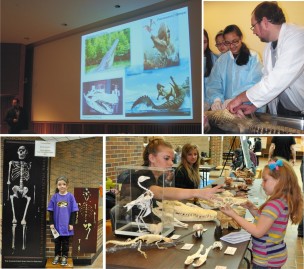
Greetings, I wanted to take this space to report on a fairly successful event were were able to pull of at Rock Bridge High School. As described previously, members of the Department of Pathology and Anatomical Sciences and the Department of Anthropology (the umbrella term we like is Integrative Anatomy) got together to host a K-12 and beyond outreach event alongside Columbia Public Schools Planetarium. Before I get started I wanted to thank everyone that put so much time and effort into the production and then execution of the event:

Libby Cowgill, Kevin Middleton, Scott Maddux, Dave Dufeau, Carol Ward, Alex Woods, Elizabeth Moffett, Sarah Swartz, Ian George, Henry Tsai, Amy Reynolds Warren, Chet Savage, Rachel Munds, Kaleb Sellers, Elizabeth Lo Presti, Ally McEntire, Ashley Hammond, Rob’yn Johnston, Zack Winkler, and finally the Director of the Planetarium Melanie Knocke.

We had 400 people come see 5, 40 minute long planetarium shows (Earth’s Wild Ride) and the Planetarium collected a little less than $500 in donations. Before and after each show, guests were given the opportunity to take part in a number of activities we developed. The movie touched on numerous parts of Earth’s tumultuous history including the Late Cretaceous Extinction event and the Late Pleistocene glaciation of Europe, hence “Dinosaurs & Cavemen”. The Missourian newspaper had a good write-up with photos. 

We front-loaded the effort on this to develop a number of activities that we can easily employ during future outreach events. As several of the faculty are always trying to figure out how to incorporate their research into broader impacts, it is events like this that not only help us get our chops up, but help expose the community to what is actually going on at Mizzou. Most people had no idea we have faculty that study Neandertals, dinosaurs, crocodiles, or other animals. Since many of the activities and tables can be transported easily (I basically emptied my office for some of the tables) I started to think about how effective a Mobile Museum would be in the this part of the country…you know…get a sweet RV filled with people and gear and go tour (like this one) some of more rural and urban schools around the state. Maybe during retirement, we can stop by Canyonlands.

The Activities:

Walk Like a Dinosaur: We cut out and placed numerous anatomically-correct stenciled tracks of Tyrannosaurus, Dromaeosaurus, Titanosaur and Australopithicus (i.e., Lucy) to parallel a kraft-paper runway. On the runway, kids could strap little theropod feet onto their shoes, dunk them in some water, and then leave prints along the trackway. Kevin devised a fairly ingenious strap-on dino sandal made from velcro straps, plywood, and sponges for this. This was a huge hit and I was even able to wear the relatively tiny sponge feet, don Henry’s mache Velociraptor mask and scare the crap out of a 4yr old. Thanks to Dana Ehret for providing the inspiration for this and Ally for supervising to make sure everything went well.

Little Lascaux: Kraft paper was hung on the wall. Stencils and examples of various Pleistocene animals that were depicted in the original cave were provided by Amy and Chet. Kids and parents and whomever was then enabled to create this massive mural on the wall. It included fire-breathing animals, rainbows, aurochs and potentially the earliest cave drawing of a hand turkey. We filled 2, 12ft murals with images that still sit rolled up in my office.

I Dig Dinosaurs: The venerable brush sand off a skeleton. Henry, Elizabeth and Ian sculpted a pretty sweet life-sized velociraptor skeleton out of ceramic clay placed it in 4 separate trays and covered it with vermiculite. We provided a poster of Velociraptor thanks to Scott Hartman as well as a copy of the Sue the T. rex quarry I still have from my younger days. This was a huge hit.

Know Your Knapping:  Alex Woods is a master knapper and held demonstrations all afternoon using a giant tool box full of stones, points, caribou antler, flint nodules, and atlatl. He always had a gaggle of kids around him as he pressure flaked, processed leather, and demonstrated how to take down a mammoth.

The Tables:

Everything Tyrannosaur: Casts, posters and help interpreting a random assortment of  tyrannosaur casts I have.

What is a Fossil?: trace fossils, molds and casts.

Cretaceous Fauna: We had some material from North America but mostly dinosaur casts I have from Gaston Design. So, this was a bit too weighted towards Asian dinosaurs. Next time we do this we’ll likely focus more on Missouri fauna and Geology, particularly if a recently submitted State grant funds us to revitalize the Missouri Chronister Dinosaur Site.

We Survived the Extinction: Basically a who’s who of vertebrate comparative material from the lab: alligators, turtles, birds, mammals, animals in jars, you name it. This was a very popular table led by Dave Dufeau and Kaleb Sellers.

Neantertal’s vs Modern Humans: Anthro (Elizabeth, Rachel, Zack) had a nice couple of tables that had posters taped down onto the tables featuring biogeography, major anatomical features and an assortment of casts and artifacts illustrating the differences between the two arguable sympatric, hybridizing recent hominids.

Digital Paleo: Finally, we had a table that had a Clear & Stained alligator on a light box the got lots of attention. Next to it were two laptops. One had a loop of the Edmontosaurus chewing movie you can find at Palaeontologia Electronica and the 2nd had a draft our our 3D Alligator Jaw Muscle pdf that is in the pipeline at PLoS. It was great to see 8 year olds be able to easily manipulate the file to check out parts of the internal anatomy of an alligator.

Below I will spam pictures from Scott Maddux and myself:

Missouri-20130309-00040 Missouri-20130309-00057 IMG_0452 DSC_0014 DSC_0006 DSC_0001 Missouri-20130309-00049 IMG_20130309_125150 DSC_0038 DSC_0027 DSC_0023 DSC_0021 DSC_0011 Missouri-20130309-00059 Missouri-20130309-00053 Missouri-20130309-00037 Missouri-20130309-00035 Missouri-20130309-00030 Missouri-20130309-00028 IMG_0449 IMG_0030 DSC_0033 DSC_0005


Leave a Comment

Filed under public education

Dinosaurs & Cavemen Public Event

Saturday March 9th. Rock Bridge High School Planetarium. 1-5pm

Saturday March 9th. Rock Bridge High School Planetarium. 1-5pm

Saturday March 9th, a brigade of University of Missouri undergraduates, graduate students, and faculty will be at the local high school planetarium to provide an afternoon of discovery and excitement open to the general public. Come by, bring your families, catch a movie, help paint “Little Lascaux”, see how your footprints compare to those of human ancestors and Tyrannosaurus, help excavate fossils, and learn how global climate change has impacted plants and animals during the Late Cretaceous and Late Pleistocene time periods. Support your local planetarium! Support your local paleontologists!

March Public Shows at the Columbia Public Schools’ Planetarium
 
Earth’s Wild Ride” Event:
Dinosaurs, Cave Men, and Our Changing Planet
 
March 9, 2013
1:00pm, 2:00pm, 3:00pm, 4:00pm
 
Sixty five million years ago, an asteroid impact contributed to the extinction of the dinosaurs.  Twenty thousand years ago, much of a cooling Earth was covered in ice. These are just two ways Earth’s surface has changed over the millennia. 
 
Columbia Public Schools’ Planetarium & the University of Missouri’s Department of Pathology and Anatomical Sciences and Department of Physical Anthropology are teaming up to show just how our changing planet effected life on its surface.
 
·        Watch Earth’s Wild Ride planetarium show and see a tour of the night sky.
·        See dinosaur fossils
·        Compare your foot print to those of a dinosaur
·        Learn how cave men lived
·        Paint a cave mural
·        and more …
 
In the Planetarium:
Earth’s Wild Ride is set on the surface of the Moon in the year 2081.  A grandfather and his grandchildren watch a solar eclipse from scenic cliffs overlooking their moon colony. As they watch the Moon’s shadow move across Earth, the grandfather tells stories of crashing asteroids, roaring dinosaurs, frigid ice ages, erupting volcanoes, and more. A star tour will be give after each show.
 
Outside the Planetarium Doors:
Learn about dinosaurs and cavemen and the different times in which they lived. See fossils and artifacts! Help paint a cave mural! Compare your footprints with those of dinosaurs!
 
Admission to this event is free, but donations of $2 per person are welcomed.
 
CPS Planetarium is located within Rock Bridge High School at 4303 S Providence Rd in Columbia Missouri.  The planetarium is open for public shows on the second Saturday of each month.   School groups and private groups can reserve a weekday show by phone (573-214-3148) or email:Planetarium@columbia.k12.mo.us

1 Comment

Filed under public education

A Brief History of Archosauriform Symphyses

Class-based evolution of the mandibular symphysis of archosauriforms. Holliday and Nesbitt, 2013.

Class-based evolution of the mandibular symphysis of archosauriforms. Holliday and Nesbitt, 2013.

Two years ago, I was invited to present in the Basal Archosaur symposium at the Latin American Congress of Vertebrate Paleontology in San Juan, Argentina. Holy cow do they know how to put on a good conference.  This symposium has turned into a Special Issue of the Geological Society of London. Papers in this volume will be trickling out over the next few months I presume. Ours is out now though. Sterling and I saw it as a good opportunity to begin a larger project on the functional significance and evolution of chins in archosaurs. Stemming from my earlier work on lizard symphyses (which we still have unpublished data of), ongoing work on crocodyliform chins, and a general interest in cranial arthrology, this paper presents the broad picture of diversity of symphyses among early archosaurs and up into the crown groups. From reading the paper, I hope people will take home just how incredibly diverse the chin, and feeding apparatus really is among this exciting group of vertebrates, and how often members of the larger group have experimented with convergent morphotypes. I think this is evidenced by the colorful character tree to the right (Fig. 12 from the paper).

One thing that I’ve been saying in the talks I give about this research that doesn’t appear strongly in the paper is that I’m not quite satisfied with the Scapino classification system as it applies to archosaurs and other reptiles. This system (Class I-IV) generally describes the overall morphology of the symphyseal plate–the ligamentous surface of the dentary that attaches to the other dentary. Using it was a good start since numerous mammal-centric papers use it to describe the joint. And I think it does an adequate job of broadly categorizing chins into unfused vs fused joints. But this does little to tell us about the internal architecture of fibers (which vary among animals, and may be woven, parallel, and/or distributed differently in the joint), the role Meckel’s cartilage has in the joint, good ole variation, and other features of the chin such as integument, dentition, the predentary, and even its complementing premaxilla. My brain shuts down a bit when I think about how to study not only the symphysis, which is complicated enough, but the symphysis+premax as a single functional unit. ow. So, we’re digging more deeply into the dark corners of characters to better describe all of this beautiful, functionally insightful anatomy (See Protosuchus figure) as well as more quantitatively explore the evolutionary and developmental patterns underpinning the joint over time.

Gorgeous MicroCT data of Protosuchus (MCZ 6727) and its sexy chin.

Gorgeous MicroCT data of Protosuchus (MCZ 6727) and its sexy chin.

Stay tuned for more symphyseal goodness in the near future. As for access to the paper, for now, email me if you want a copy.

Citation: Holliday CM, Nesbitt SJ. 2013. Morphology and diversity of the mandibular symphysis of archosauriforms. Geological Society, London, Special Publications v379. 17pp. doi 10.1144/SP379.2.

Abstract: Archosauromorphs radiated into numerous trophic niches during the Mesozoic, many of which were accommodated by particular suites of cranial adaptations and feeding behaviors. The mandibular symphysis, the joint linking the mandibles, is a poorly understood craniomandibular joint which may offer significant insight into skull function and feeding ecology. Using comparative data from extant amniotes, we investigated the skeletal anatomy and osteological correlates of relevant soft tissues in a survey of archosauromorph mandibular symphyses. Characters were identified and their evolution was mapped using a current phylogeny of archosauriforms with the addition of non-archosauriform archosauromorphs. Extinct taxa with the simple Class I condition (e.g., proterochampsids,rauisuchians”), rugose Class II (aetosaurs, protosuchians, silesaurids), and interdigitating Class III symphyses (e.g., phytosaurs, crocodyliforms) and finally fused Class IV (avians) build the joints in expected ways, though they differ in contributions of bony elements and Meckel’s cartilage. Optimization of the different classes of symphyses across a archosauromorph clades indicate that major iterative transitions from plesiomorphic Class I to derived, rigid Class II-IV symphyses occurred along the lines to phytosaurs, aetosaurs, a subset of poposauroids, crocodyliformes, pterosaurs, and birds. These transitions in symphyseal morphology also appear to track with changes in dentition and potentially diet.

Leave a Comment

Filed under Research News

Transactions of the Royal Sounds of SVP

Yes, the seats squeaked upon sitting on them at this year’s Society of Vertebrate Paleontology meeting. During talks, most people sought to avoid the chirping by gently sliding laterally onto the cushion. But at the banquet, every applause was followed by waves of seat barks. Stay classy SVP!

All in all, the meeting was well executed, at a great location. Well done Host and Program Committees, and all the participants that made it possible.

3 Comments

Filed under academia, Research News, Uncategorized

Calls of the Wild

By: Ally McEntire

The calls of the baby gator in the Holliday lab got me thinking about alligator vocalizations. On a whim, I decided to look this up and found a little more than I had bargained for. Alligators and other crocodilians have a different vocal structure than any other reptile, amphibian or bird– all nearby relatives. Their vocal structure is actually quite similar to that of mammals. Instead of a syrinx like birds have, which involves air passing through the trachea while it vibrates at different rates; they have vocal folds—a larynx—just like humans.

This article details a study done on live juvenile crocs to study their vocalizations. It discusses a number of very specific things like sexual dimorphism in calls and amount of time the noises lasted. What I find more interesting than all of that is that their vocal structure is so unique. Even though they are evolutionarily related to these 3 other branches, their system of making noise is not really like any of their closest relatives. Basically, they have vocal folds, which contract and/or relax when the gator breathes out, like mammals.

This made me want to find out more about the ancestral line, if the present one is so estranged. Would other archosaurs resemble birds, lizards or crocs more closely? I’m not sure there’s a way to know this, considering the vocal cords are a soft tissue, and therefore incredibly difficult to preserve. But, if there were tissue attachments that could be identified, I think it’s something worth looking into.

Also, if you’re curious to hear our captive alligator making his own vocalizations, check Romer out here:

Romer Chirping

Leave a Comment

Filed under Uncategorized

Reaching Out for Science

What is it that scientists do all day while they are watching their shrimp walk on a treadmill?  How do scientists know how Tyrannosaurus may have chewed or ran? How do they know if a molecule will work as a drug to target some disease? Scientists often find it difficult to translate their work’s importance to the public in a way they can understand without losing some of its content. Often “laypeople” are left confused with what looks like a waste of money in the name of big science.

So, how can the general public learn more about the inner workings of a research laboratory? Perhaps the key is to train student researchers early in their careers on how to write about science to the average person.

As a social experiment this year, members of the Holliday lab will try to bridge this gap by writing their own short pieces on relevant and interesting science.

By learning to translate often wonky, jargon-laden research to more palatable, engaging prose, lab members will hope to shed light on what happens in our lab, what questions we are asking, what discoveries we hope to make, and most importantly, why anyone should care.  

Of course, this should help the writers learn about science as well. Although the lab focuses on Vertebrate Functional Anatomy and Evolution, do not be surprised if other topics creep in. 

Leave a Comment

Filed under Uncategorized